Custom Tin Box Cost: What Drives the Price and How to Lower It
Ask three suppliers for a custom tin quote and you can get three very different numbers, because a tin's price is built from several independent decisions rather than one list price. Understanding the custom tin box cost drivers lets you design a tin that hits your budget on purpose, instead of trimming it after the quote lands. Here is what actually moves the price, and where you have room to save.
The two costs inside every quote
A custom tin price has two parts. First, one-time setup: tooling for the shape, printing plates, and colour calibration on metal, all of which happen once no matter how many tins you order. Second, the per-unit cost of material, printing, forming, and assembly, which repeats for every piece. The setup is fixed, so the more units you spread it over, the lower the effective price per tin. That single fact explains most of what follows.
Size and material
Bigger tins use more tinplate, so material is the most direct lever on unit cost. A larger footprint or a deeper wall means more steel per piece and, at scale, a meaningful difference. If your product fits a slightly smaller tin without looking cramped, you save on every unit for the life of the line. Interior lining also plays a part: a food-grade lacquer is needed for edible contents, while non-food items such as candles or cosmetics may not need one, which trims cost.
Shape: stock versus new tooling
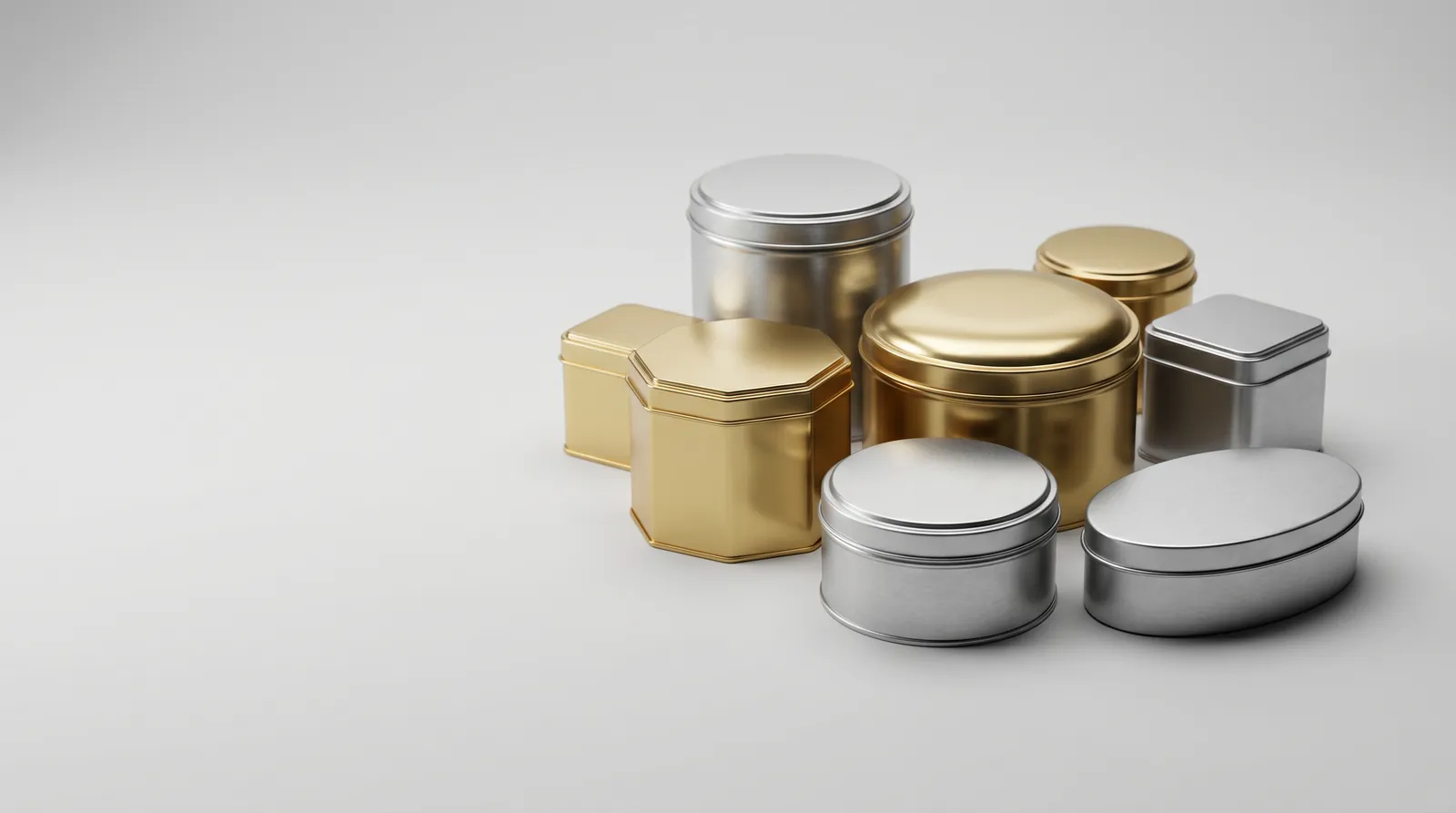
This is often the single biggest swing in a first order. A stock shape, an existing size the factory already tools, carries no new tooling charge, so you pay only for print and forming. A bespoke shape requires a new steel die, a one-time cost that has to be recovered across the run. On a small first order, custom tooling can dominate the quote. If a standard footprint is close enough, choosing from the existing custom tin boxes range instead of commissioning a new die is the fastest way to bring the price down.
Quantity and MOQ
Because setup is fixed, the per-unit price falls steeply as quantity rises, then flattens. Custom offset-printed tins typically start at a minimum order quantity in the region of 5,000 to 25,000 pieces per design and size, and ordering at or above that minimum is almost always better value than asking for an uneconomically small batch. Buying at scale is why wholesale tin boxes reach a far lower unit price than a short bespoke run. If your demand is uncertain, size the order to realistic 6-to-12-month sales rather than a single launch.
It helps to picture the curve. The step from a very small batch up to the MOQ is dramatic, because you finally have enough units to absorb the tooling and print setup. Past the minimum, larger volumes keep helping but with diminishing returns, since only material, printing, and forming still scale. In practice that means there is little value in ordering far below a sensible minimum, and a clear reward for consolidating demand into fewer, larger runs. If you are launching cautiously, it is often smarter to commit to one economical run and hold stock than to place two tiny runs and pay the setup twice.
Print colours and coverage
Offset printing on tinplate uses CMYK, and each additional Pantone spot colour or metallic ink adds a plate and a pass, which adds setup and a little run cost. A design that lives happily within CMYK plus one carefully chosen spot colour costs less than one demanding several exact-match Pantones and full metallic coverage. Heavy, edge-to-edge ink also uses more than a design that leaves areas of bare tinplate, which can look premium in its own right.
Finishes
Finishes are worth the money when they earn their place, but they are optional cost. Embossing, debossing, and spot varnish each add a tooling or process step. The trick is to choose the one or two effects that most lift perceived value, rather than stacking every option. A single embossed logo under a matte varnish often reads as more premium than a busy combination, and costs less.
Lids and complexity
The closure changes both material and assembly cost. A simple slip-on lid is the most economical; hinged, screw, window, or domed lids add components and steps. Match the lid to genuine function: if the product does not need a resealable or windowed closure, a slip-on keeps the price lean without hurting the result.
Where the money is best spent
Not every cost is worth cutting. The point of a decorative tin is perceived value, so trimming the wrong thing can cost you more in lost shelf appeal than it saves in unit price. A useful way to prioritise is to protect the two or three details a shopper actually notices, the shape, the hero finish, and colour accuracy on brand-critical elements, and economise on the rest. Cutting a needless second Pantone or a lid feature nobody uses rarely hurts the result; cutting the one embossing that makes the tin feel giftable often does. Spend where the customer's eye lands, and save where it does not.
It also pays to think across the whole line rather than a single tin. If three products can share one shape, you tool once and print three artworks, so the setup is recovered across all three runs instead of each carrying its own. Planning a season this way, deciding the core range and the limited editions together, is one of the most effective levers on average unit cost, and it is a decision made long before the quote rather than after it.
How to lower your custom tin cost
- Use a stock shape to avoid new tooling wherever a standard size fits.
- Order at or above the MOQ, and size the run to real demand so setup is spread over more units.
- Share one shape across SKUs, changing only the printed artwork, so several products help clear one economical run.
- Keep the palette disciplined: CMYK plus one spot colour rather than several exact Pantones.
- Choose finishes selectively, one hero effect instead of many.
- Pick a simpler lid when function allows.
- Combine seasons, running a holiday edition and a core line together where possible.
Get an accurate figure
Every project prices differently, so ranges only take you so far. To quote your exact tin, a supplier needs the use case, a target size or shape, your artwork or a rough idea, your desired finishes and lid, and your expected volume. Share those and you get a real number rather than a guess. When you are ready, request a quote and you will receive a per-unit price for your specification, along with a free sample to confirm the result on metal.
Avete in mente una latta?
Indicateci forma, formato e grafica. Inviamo un preventivo e un campione gratuito, e rispondiamo entro poche ore.
Richiedi un preventivo