Passover Gifts in Tins: A Planning Guide for Gift Companies
Passover is a season of gifts. Guests bring something to the Seder table, families send parcels to one another, companies give to their customers, and in some countries employers give every member of staff a holiday gift. Whoever sends them, the gifts that are bought by the hundred or the thousand pass through the same few hands: gift companies, confectioners, kosher grocers and caterers, and the purchasing departments of large employers. This article is about the container for those gifts. It is written for the people who assemble Passover gifts in volume, and for the organisations large enough to buy the packaging themselves.
What makes a Passover gift different
Two things. The first is what may go inside. For the week of Passover leavened food is out, and any food or drink in a gift has to be kosher for Passover — which is certified on the food, product by product, by the body that supervises whoever makes it, or whoever packs it if food goes into the gift loose. That makes the choice of food narrower than at any other time of the year: wine, and chocolate, sweets and nuts made for the holiday, are the familiar ones. When the contents are that alike from one gift to the next, the container does more of the work of telling one company’s gift from another’s.
The second is what happens afterwards. Most gift packaging is finished on the day the gift is opened. A Passover tin has a second use built into the calendar: a matzah tin can go back on the table the following year, and so can a Seder tray. A box that comes out again every spring with a company’s mark on its lid is the part of a corporate gift the sender is really paying for.
The formats in the range
A Passover gift is several different things in one parcel, and a rigid box holds them together without crushing them. In our Passover range three sizes are meant for a filled gift rather than a single product:
- 345 × 225 × 130 mm: the hamper, our deepest gift box.
- 240 × 140 × 70 mm: the deep rectangle, for a mixed assortment.
- 190 × 135 × 60 mm: the mid-size box, with room for two or three different items.
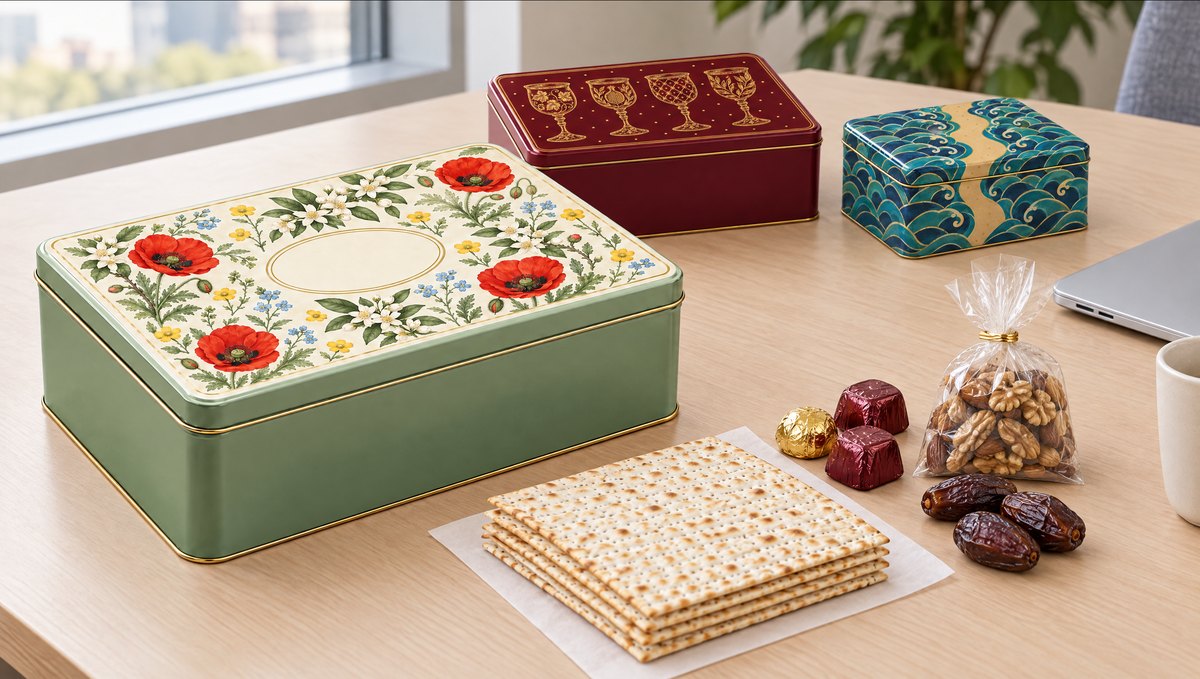
Three more pieces do jobs that belong to this holiday. The matzah tin is square, 215 × 215 mm, and is drawn 110 mm high, for square machine-made matzah in its own pack; the height is set to your pack, so send us one before you fix the size. Round hand-made matzah does not fit it. The Seder tray, Ø325 mm, is a printed tray for the Seder table: the foods sit in small bowls placed on it, it has no lid, and it is not sold as a food container. And the small round tin, Ø99 × 60 mm, is the size for an afikoman prize or sweets for a child. All of them are moulds we already own, so there is no tooling cost and no tooling wait.
Those dimensions are the only promise we make about capacity. What fits depends on your products and on how they are wrapped, and the honest way to find out is to fill one: ask for a sample of the size you are considering and pack it on your own table. A wine bottle is the usual question: it does not stand in any of these, and of the three only the 345 mm box is long enough to take one lying down — try yours in a sample before you count on it. A sample is free — an existing tin, not printed with your artwork, with only the courier cost on your side.
A company name on the lid, three ways
The blank oval. One design in the range was drawn for exactly this. On the 345 × 225 × 130 mm box — red poppies, white citrus blossom and small wildflowers over ivory, on a sage-green body — an oval in the middle of the lid is left empty on purpose. A logo, a greeting or a dedication prints into it. It is the fastest route to a branded holiday gift, because the mould and the artwork both already exist.
A name alongside the pattern. The other gift designs can take a name or a logo on the lid next to the pattern. The design itself stays shared: it is ours, and anyone can order it. Only what you add is yours.
Your own artwork. The same moulds print with a design that is entirely yours: company colours, your own illustration, your own greeting. The timing is the same four to six weeks from approval, and that artwork is not offered to anyone else.
The ready-made designs carry no greeting, and that is deliberate: the greeting belongs to whoever sends the gift, in their own words. The only word on any of them is on the matzah tin — מצה, the name of what is inside.
A practical note for gift companies that serve many clients. A name printed on the tin makes sense when one client takes the whole run. When the same tin goes to twenty clients, the usual way is to order the design without a name and let each client’s card, band or label carry it.
The numbers, stated plainly
The minimum is 5,000 pieces per design, and one order can combine several designs and sizes. That is a workable quantity for a large gift company filling orders for many customers, for a retail chain or for a very large employer. It is the wrong quantity for an office of two hundred people. If you need a few hundred gifts, the supplier you want is a gift company that buys its packaging in volume and fills it for you. If you are that gift company, this is written for you. The reasoning behind minimums is in our article on custom tin minimum order quantities.
What goes inside is yours
We make the packaging, not the gift, and a few things follow from that. Kosher for Passover is certified on the food, by the body that supervises whoever makes or packs it, and that certificate comes with the food. How strict a standard the gift follows is for the sender and the supplier of the food to settle. What we issue for the tin is a food-contact declaration of conformity, for a tin with a food-grade lacquer inside, made under an ISO 22000 food-safety system. Passover supervision is stricter than the rest of the year and may ask about the packaging itself; if yours does, raise it before you order. A supervision mark or the words “kosher for Passover” on the tin are part of your own artwork, like your name: they are yours to supply, as your certifier approves them.
And a decorative tin is not airtight. The lid closes the tin and protects what is inside against knocks; it does not seal it. Matzah, chocolate and nuts go in wrapped or bagged, exactly as they would into a carton.
The calendar, with one extra step
Passover is fixed in the Hebrew calendar, so its civil date moves: Seder night falls on the evening of 21 April in 2027, of 10 April in 2028 and of 30 March in 2029. A gift is handed out before the holiday, not on it — a company gift to staff usually in the last week or two. Printed tins are ready four to six weeks after the artwork is approved; after that come freight and your own filling. Artwork approved by mid-January is comfortable for a late-April Passover such as 2027; for an early-April one such as 2028, make it December; and for an end-of-March one such as 2029, November. Artwork approved in March is late in any year.
Company orders add a step a household never has: someone has to sign off the artwork, and often more than one person. The four to six weeks start when the proof is approved, not when it is sent, so the approval round is the part of the schedule worth starting first.
A gift company has one more date in front of all of these: its own catalogue. Its customers choose their gift well before anything is packed, so the tin has to be chosen — and the order sized — before the catalogue is made. What you can show in it before you order is the design as it is drawn on our page and an unprinted sample of the size; a printed tin exists only once the run is made.
Where to start
Tell us three things: which Passover you are ordering for, how many gifts you expect to pack, and whether you want a ready-made design or your own. The designs are on the Passover tins page, the wider picture for company gifts is on our corporate gifts page, and a request goes in from the request for quotation page.
Frequently asked questions
What is the minimum order for Passover gift tins?
5,000 pieces per design. One order can combine several designs and sizes from the range.
Can our company logo be printed on the tin?
Yes. One design, on the 345 × 225 × 130 mm box, has a blank oval left empty for a logo, a greeting or a dedication, and the other gift designs can take a name alongside the pattern. You can also print artwork that is entirely your own on the same moulds.
Is the tin kosher for Passover?
Kosher for Passover is certified on the food, by the body that supervises whoever makes or packs it, and that certificate comes with the food. We make the packaging: tinplate with a food-grade lacquer inside, produced under an ISO 22000 food-safety system, with a food-contact declaration of conformity. Passover supervision may ask about the packaging itself; if yours does, raise it before you order.
When does the artwork have to be approved?
Printed tins are ready four to six weeks after artwork approval, and freight and your own filling come after that. A gift is handed out before the holiday, so artwork approved by mid-January is comfortable for a late-April Passover, December for an early-April one, November for an end-of-March one, and March is late in any year.
We need only a few hundred gifts. Can you supply them?
Not as printed tins: the minimum is 5,000 pieces per design. For a few hundred gifts the right supplier is a gift company that buys its packaging in volume and fills it for you.
Custom tin packaging
Ready-made tin ranges
Related sectors
Matching tins


Have a tin in mind?
Tell us your shape, size and artwork. We send a quote and a free sample, and reply within hours.
Request a quote