Purim Tin Packaging: A Planning Guide for Mishloach Manot
Purim has a property no other gift season has: every parcel is due by the same day, and on the civil calendar that day moves from year to year. A gift company, a chocolatier or a bakery that packs mishloach manot cannot be a week late, and cannot let the range sell on for a few more weeks the way most seasonal lines do. This guide is for the people who buy the packaging for that day. It covers when to order printed tins, which size holds what, how many make sense, and what a tin maker can and cannot tell you.
Start from the date and count backwards
Purim falls on 14 Adar — in a leap year, 14 Adar II — so on the civil calendar it lands anywhere from late February to late March. The next four:
- 2027: Tuesday 23 March
- 2028: Sunday 12 March
- 2029: Thursday 1 March
- 2030: Tuesday 19 March
Each begins at sundown the evening before, and Jerusalem keeps Shushan Purim a day later. Mishloach manot are given on the day itself, which means the parcels have to be packed and ready before it, not on it. In 2028 the day is a Sunday, so for anyone who keeps Shabbat the last working day before it is Friday 10 March, and in many workplaces Thursday 9 March.
From that fixed point four things have to fit, working backwards: your own filling and packing, freight from our factory in İstanbul to your door, production of the tins, and approval of the artwork. Production is the part we can state as a rule: on a mould we already own, printed tins are ready four to six weeks after you approve the artwork. Freight depends on where you are and how the goods travel, so it comes as a date with your quotation, not as a rule of thumb. Your filling time you know better than we do.
Put together, the practical answer for a Purim in March is this: artwork approved in December is comfortable; artwork approved in February is late. In a year like 2029, when the day falls on 1 March, everything moves earlier with it.
Which tin holds what
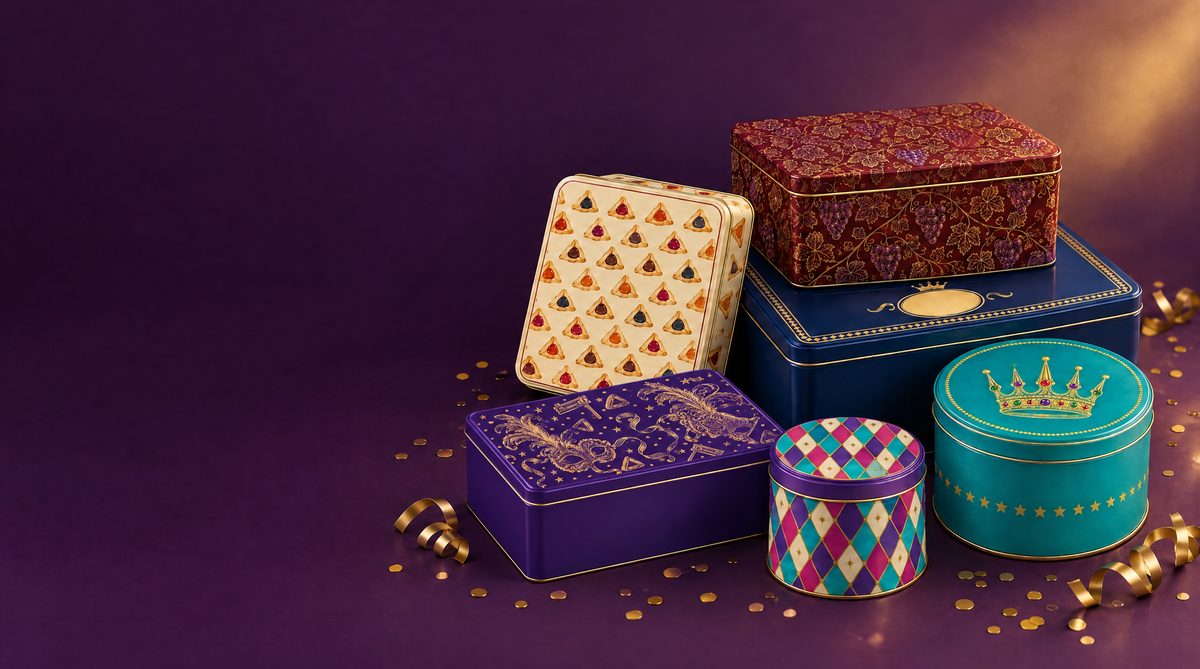
Mishloach manot asks for at least two different ready-to-eat foods, so the container has to take several things at once and survive being carried from door to door. Six of our existing moulds carry the Purim range, and between them they cover the parcel sizes we are asked about most:
- Ø99 × 60 mm, round: the small one — a classroom gift or a handful of sweets.
- Ø133 × 85 mm, round: deep enough for a stack rather than a single layer.
- 190 × 135 × 60 mm, rectangular: a mid-size box with room for two or three different items.
- 190 × 190 × 45 mm, square: a single layer of hamantaschen or pralines.
- 240 × 140 × 70 mm, rectangular: a mixed assortment.
- 345 × 225 × 130 mm, rectangular: the hamper, for a filled gift rather than a single product.
Those dimensions are the only promise we make about capacity. How many pieces fit depends on your product and on how it is wrapped, and the honest way to find out is to fill one: ask for a sample of the size you are considering and pack it on your own table. A sample is free — an existing tin, not printed with your artwork, with only the courier cost on your side.
A ready-made design or your own
There are two ways to put a Purim design on these tins.
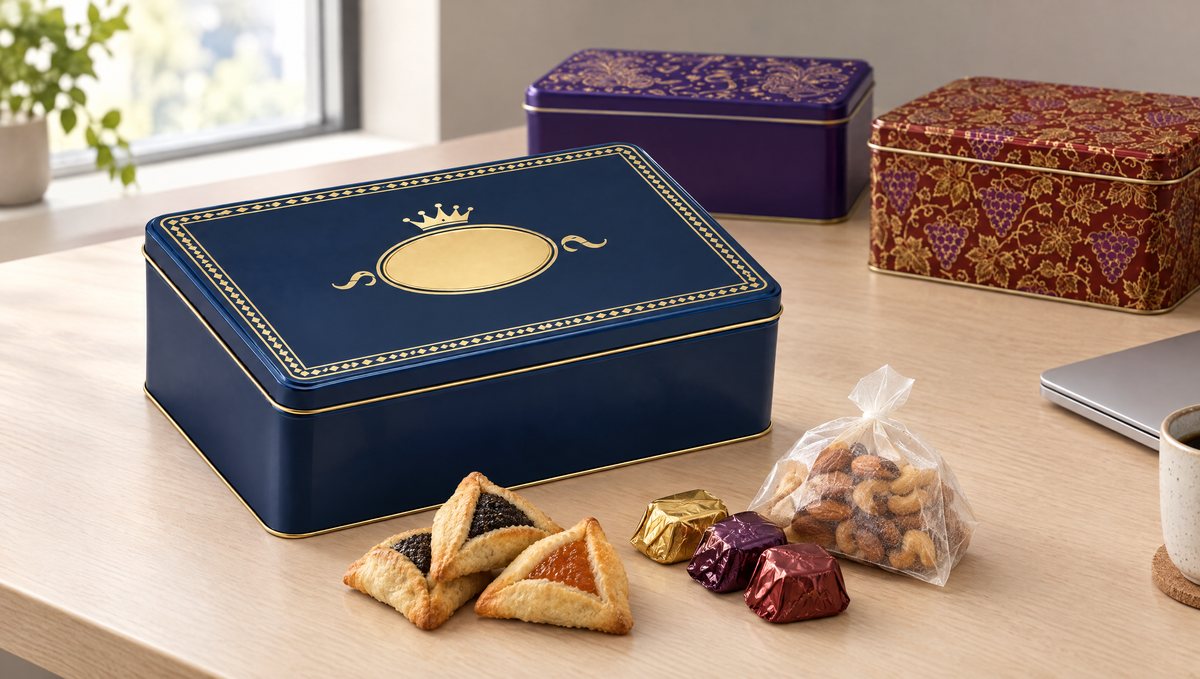
The first is the ready-made range: six designs we have already drawn, one on each of the six sizes — hamantaschen, harlequin diamonds, masks and noisemakers, a crown, a blank gold cartouche and a vine. There is nothing to design and no tooling involved, and a name, a logo or a greeting can be added to the lid. The limit is the one stated on the range itself: a ready-made design is not exclusive. Anyone can order the same tin. All six are on the Purim tins page.
The second is your own artwork on the same moulds. The timing is the same four to six weeks from approval, and the artwork is yours alone. Our studio lays your design out on the tin and sends a colour proof before the press runs. Either way the finish is your choice: matte or gloss are both possible.
Buyers often ask why the ready-made designs carry no human figures and no lettering. Both are deliberate. A figure on a lid is one illustrator’s idea of Esther, and the buyer then has to stand behind it; the objects of the day — hamantaschen, masks, the noisemaker, the crown — need no defending. Lettering is left off because the greeting belongs to whoever sends the gift, in their own language and their own typeface.
Food contact and kashrut
Every food tin we make has a food-grade lacquer on the inside and is produced under an ISO 22000 food-safety system. What we issue for it is a food-contact declaration of conformity. Kashrut is a different matter: it is certified on the food, and that certificate belongs to whoever fills the tin. We make the packaging, so we make no claim either way. If your certifying body needs anything for the packaging itself, raise it before you order.
One more thing we say plainly to every food customer: a decorative tin is not airtight. The lid closes the tin and protects what is inside against knocks; it does not seal it. Anything that needs a barrier — hamantaschen, chocolate, nuts — goes into the tin in its own wrap or bag, exactly as it would into a carton.
How many
The minimum is 5,000 pieces per design, the same as for any printed tin. One order can combine several designs and sizes from the range, so a small tin, a mid-size box and a hamper can come out of the same production. Whether 5,000 is a lot depends on who you are. For a company that fills parcels for many customers, for a retail chain or for a producer with its own shops it is an ordinary run. For a single shop it is too many, and we would rather say so now than at the quotation. The reasoning behind minimums is in our article on custom tin minimum order quantities.
What to send us
Three things are enough to start: which Purim you are ordering for, the quantity you expect to pack, and what goes inside — or simply the size you have in mind. With those we can propose the format and give you a production date and a price. The designs are on the Purim tins page, company orders are covered in our article on corporate mishloach manot, and a request goes in from the request for quotation page.
Frequently asked questions
When should Purim tins be ordered?
Count backwards from the date. Printed tins are ready four to six weeks after artwork approval; freight and your own filling come after that, and the parcels have to be packed before the day. For a Purim in March, artwork approved in December is comfortable and artwork approved in February is late.
What is the minimum order for Purim tins?
5,000 pieces per design. One order can combine several designs and sizes from the range.
Which size suits a mishloach manot parcel?
Mishloach manot needs at least two different ready-to-eat foods, so the mid-size tins are the usual choice: Ø133 × 85 mm or 190 × 135 × 60 mm for two or three items, 240 × 140 × 70 mm for a mixed assortment and 345 × 225 × 130 mm for a hamper. The reliable test is to fill a sample with your own products.
Can we print our own design instead of a ready-made one?
Yes. Your own artwork prints on the same moulds in the same four to six weeks from approval, and it is yours alone. A ready-made design needs no design work, but it is not exclusive: anyone can order the same tin.
Are the tins kosher?
Kashrut is certified on the food, and that certificate belongs to whoever fills the tin. We make the packaging: tinplate with a food-grade lacquer inside, produced under an ISO 22000 food-safety system, with a food-contact declaration of conformity. If your certifying body needs anything more for the packaging, raise it before you order.
Custom tin packaging
Ready-made tin ranges
Related sectors
Matching tins
Have a tin in mind?
Tell us your shape, size and artwork. We send a quote and a free sample, and reply within hours.
Request a quote